
Defining brand engagement for ecommerce
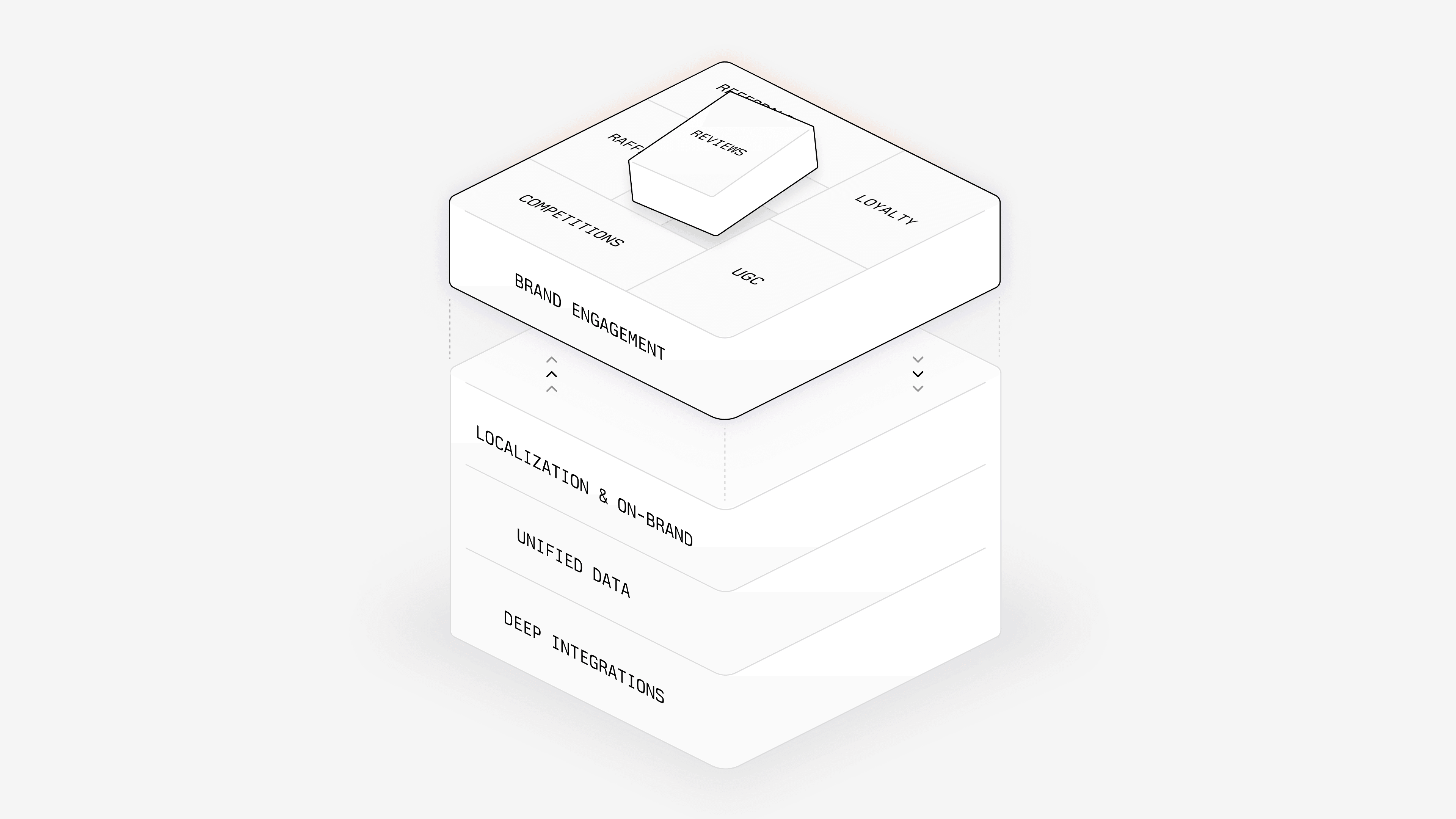
Brand engagement is the discipline of turning brand love into brand value: the strategies, tooling, and data layer that move customers from passive buyers into an active relationship with a brand.
Think of a customer who loves your brand. They continue buying your product, they're active in your loyalty program, they tag you on Instagram, they leave reviews and give feedback. That's not just a customer, that's a fan of your brand.
Historically, these engagement touchpoints have been treated as siloed strategies. From the customer's perspective, they aren't separate. They're just different ways the same person interacts with the brand they love. The separation didn't come from how brands and customers see the relationship; it came from vendors who built niche solutions and forced brands into siloed data and scattered experiences.
Treated as one engagement discipline instead of separate strategies, the touchpoints unlock synergies and efficiency. We call it brand engagement.
How customers relate to brands
Customers relate to brands across a range, from a one-off buyer to someone who can't stop talking about your products. The brands that win the relationship don't leave it to chance. They design for three roles a customer can take, and the best customers take all three.
Consume. The customer takes in what the brand sends. Emails, SMS, organic social posts, all aimed at inspiring them and bringing them back. The brand is the one talking.
Participate. The customer shows up and acts. Joins the loyalty program, enters the competition, posts in the community, shows up to an event. The customer is the one moving.
Contribute. The customer gives something the brand can use. Photos, videos, reviews, data, feedback, ideas. The customer becomes part of the brand and helps inspire other customers.
Consume is the passive role. CRM tools call it customer engagement and stop there. Brand engagement lives in Participate and Contribute, where the customer is the one taking action.
Defining brand engagement
Brand engagement is collaborative, always-on work. It happens before, during, and between purchases, with the people who love your brand most.
There are seven brand engagement strategies: reviews, UGC, loyalty programs, competitions, zero-party data, referrals, and hosted communities. Each strategy comes with its own purpose and dynamics, and unlocks synergies with the others.
These are the building blocks of a full brand engagement strategy. Not every brand runs all seven, and not every brand runs them the same way. The right mix is brand-specific and yours to build.
Why brand engagement matters
The old ecommerce playbook (buy traffic, convert it, email the list) is breaking on both ends. Paid acquisition keeps getting more expensive. Email and SMS open rates keep sliding. The traditional toolkit still works, it just produces less per dollar than it used to.
Meanwhile, the customers a brand already has are becoming its most valuable asset and the least operationalized one. Most sit in a CRM as addresses on a list rather than people in a relationship. Moving them from enrolled to active is what brand engagement does, and customers on the active side of that line buy more often, talk about your brand, and produce the content that brings in the next cohort.
Brand engagement is the discipline of operationalizing the post-purchase relationship and treating it the way acquisition has been treated for fifteen years: with its own strategies, tooling, and seat at the table. Not as retention. Not as "loyalty," which in most brands means a points balance nobody looks at. As the other half of the funnel, finally getting the attention the first half has had all along.
The brands that figure it out first get four things competitors can't easily copy:
- An uncopyable moat. AI can clone your product line and undercut your pricing in an afternoon. It can't clone what your customers feel about your brand.
- A base of customers who actively participate. Not a list. A base. People who show up, contribute, refer, and stay.
- A data layer that survives cookie deprecation. Zero-party and first-party signal, accumulating into a profile every other system gets better because of.
- Marketing leverage that compounds. Every engaged customer produces content, data, and word of mouth that lowers your cost of acquiring the next one.
The shift isn't a tactic. It's the rebalancing of a funnel that's been lopsided for a decade and a half.
Building blocks of brand engagement
Putting brand engagement into practice comes down to choosing the right strategies for your audience. You don't necessarily need to deploy all of these at once; think of them as a toolkit rather than a mandatory checklist. Here are the seven core building blocks you can use to build an active relationship with your customers.
Reviews
Product reviews are customer feedback on a specific product, written in the customer's own words. At a minimum, a review is a star rating, and usually a comment. The better reviews go further by capturing product-specific properties such as experienced fit, and information about the reviewer such as height and what size they usually wear.
Alongside product reviews, there are brand experience reviews. These cover the broader experience of buying from the brand: shipping, customer service, returns, and the overall feel of the company.
The primary purpose of reviews in ecommerce is social proof, helping new customers answer one question: what experience did people like me have with this product or brand? The more concrete the review, the more useful the answer.
The secondary purpose is feedback. Reviews open a channel to the brand on what's working and what isn't across the product, the delivery, and the support. Read carefully, they're a free source of ongoing customer research.
One principle matters most: don't curate reviews. The full spectrum, including the negative ones, is what makes them useful to the next customer. A wall of five-star reviews reads as suspicious, and the point is to make the next customer informed, not to make the brand look good.
UGC
UGC (user-generated content) is photos and videos that customers have created about the brand or its products. It's visual rather than textual, often selected for brand fit (unlike reviews), and doesn't need to be studio-quality. The point is that it's genuine.
The primary purpose of UGC in ecommerce is inspiration. Where a review answers "did people like me have a good experience," UGC answers a different question: "what does this look like in someone's actual life?" It opens up use cases, styles, and lifestyle contexts. The product appears in environments the brand's own photography never reaches.
UGC has a spectrum of authenticity, from customer-led content to paid creator partnerships. The more authentic, the better it performs as social proof.
UGC has two main sources:
- Social media. By far the biggest. When customers post on their own channels, the brand gets extended organic reach, and the quality of the content is generally higher.
- Direct uploads. Customers submit content directly to the brand. This streamlines rights management and brings in customers who don't post publicly. The average quality is lower than social.
Once collected, UGC is useful across the website and in emails. The two main placement types are:
- Product surfaces. Product pages, collection pages, abandoned cart emails.
- Inspiration surfaces. Home page, landing pages, newsletter.
The most important step is adding shoppable product tags. They let visitors buy directly from the content that inspired them, turning each UGC post into a conversion engine.
Loyalty programs
A loyalty program rewards customers for repeat purchases and other behaviors the brand wants to encourage. The classic version is points for purchases, redeemable for discounts. The modern version allows brands to reward a broader range of behaviors:
- Share data
- Answer questions
- Submit content
- Participate in competitions
- Show up to events
Rewards can take many forms:
- Discount codes and store credits
- Brand-experience rewards like invitations to events, early access, or digital resources
- Gamified rewards like raffles or mystery prizes
A clear tier structure gives customers progress to look forward to. It rewards your most active customers and incentivizes long-term relationships. Aligning earning periods and expirations with the purchase frequency in your category creates a cadence: a sense of urgency and room for bigger events through the year.
The mix is what creates a distinctive program. A generic points-for-discounts program is functional but says nothing about the brand. A program that also rewards the specific behaviors the brand cares about, with rewards that fit the brand identity, becomes part of the brand experience itself. Done well, your loyalty program gives back to the most engaged customers and turns participation and purchases into a habit.
Competitions
A competition is a time-bound event that invites customer participation, usually with a prize or recognition for entries. Competitions give the brand a reason to talk to customers, and customers a reason to engage outside the routine of a purchase. They create hype and excitement around the brand. There are two main forms:
- Completion-based. Participants submit something or answer questions.
- Lottery-based. Any customer who qualifies gets entered into a draw.
Competitions can live on-site or on social media. Historically, they've been built and managed manually. The better approach is to integrate them into your loyalty program, with rewards handled in one place.
Beyond hype and excitement, competitions produce data and content from every participant. Run routinely (one a month, one a quarter, one a year), they become something customers look forward to and a reason to stay engaged between purchases.
Zero-party data
Zero-party data is information the customer gives the brand directly, voluntarily, knowing what they're sharing. Preferences, sizes, styles, lifestyle: the kind of things a customer would tell a salesperson in a store.
Zero-party data has three main uses:
- Insights. Aggregate data tells you what your customer base actually looks like, what they value, and what they want.
- Personalization downstream. Better email, SMS, on-site experience, and product recommendations. The personalization itself isn't brand engagement, but the collection is.
- Enrichment of reviews and UGC. Attaching a creator or reviewer's height, skin tone, and preferred styles makes the review or content more relevant for the next customer.
Zero-party data is more accurate than third-party cookies because the customer gives the brand the information directly. Collection can happen in places like the preference section of a customer's account or as a task inside the loyalty program, where the brand gives back points or a reward in exchange for the information.
Referrals
Organic word of mouth happens when a customer who loves your brand tells their friends, posts on social, or mentions the brand at dinner. It's the natural output of a great brand experience and occurs without a referral program.
A structured referral program incentivizes the same behavior with a discount code or referral link. The customer sends a link to a friend. Both get a discount or reward. The brand gets a new customer.
The upside is real. Customers actively bring in new customers, and the new ones come pre-warmed by the recommendation.
The risks are also real. The first is misuse, where customers game the system. The deeper risk is that a discount-driven referral can decrease the value of the recommendation itself. Customers are more likely to buy based on a genuine recommendation than because a friend got a $5 coupon.
The lesson isn't "don't run referrals." Design them so the recommendation matters more than the discount.
Hosted communities
A hosted community is a space where customers talk and interact with each other, as an extension of brand-to-customer communication. Hosted communities can take different forms, such as the brand's website and app, Facebook groups, or Discord servers.
A hosted community is distinct from a customer-led one. Customers sometimes create Facebook groups or chats around a brand on their own, inviting each other in without the brand's involvement. A hosted community is set up and moderated by the brand.
If you host one, be part of it yourself and invite your co-workers to it. This gives you an ear on the ground but also gives engaged customers an even deeper relationship with your brand and the people behind it.
A good community gives a sense of belonging, the kind of brand loyalty that doesn't undo easily. It gives peer-to-peer help: questions answered, recommendations shared, problems solved without involving support. It surfaces fans of your brand and can create friendships. Additionally, it gives external social proof when prospective customers research the brand and find an existing community.
The synergy between brand engagement strategies
Each building block produces value on its own. But the blocks compound when they're connected. Profile, content, data, and signal flow between them, and each block makes every other block work better.
This is where most brand engagement stacks fail. A brand picks a separate reviews tool, a UGC tool, a loyalty tool, and runs competitions manually. Each does its job. None of them talk to each other. The customer who left a five-star review, posted UGC on Instagram, and earned 2,000 loyalty points looks like three different people across three different systems. The brand has the relationship. The stack doesn't know it.
A connected engagement layer changes the math:
- Zero-party data enriches reviews and UGC. Instead of a generic review, the next customer sees one from someone with their height, skin tone, or body type. The same data turns UGC into "people like me wear this." Social proof gets sharper without producing more of it.
- Loyalty rewards content and data, not just purchases. Points for reviews, UGC, competition entries, and zero-party data updates generate more of all of them. The customers most likely to contribute are the same ones most likely to participate. The program rewards what the brand already wants, and creates more of it.
- A unified profile turns scattered signals into compound insight. Every review, post, entry, redemption, and data point feeds the same record. The profile gets richer with every interaction, every block downstream gets better because of it, and the brand finally sees what the customer has seen all along: one relationship, not seven.
The blocks aren't additive. They're multiplicative. Two connected blocks produce more than two parallel ones. Five connected blocks produce something only a connected stack can deliver.
That's what siloed data actually costs you. Not friction. The inability to act on what the customer is already telling you. The customer who reviewed your product, posted it on Instagram, and joined your community isn't three data points. They're a fan. A connected stack treats them like one.
Two ways to get there. Use a platform built for it, or stitch point tools together at the data layer. The second path is the one most brands try and most abandon. Integrations break. Data falls out of sync. The profile fragments faster than it accumulates. The team ends up doing maintenance instead of momentum.
The brands that get this right build something competitors can't catch up to.
Your brand's approach to brand engagement
The seven blocks aren't a checklist. They're a palette. And the right mix isn't the one your competitor runs or the one a category playbook recommends. It's the one designed around the relationship you want with your customers.
So start there. Picture your most engaged customer two years from now. What are they doing with your brand beyond buying? Posting your product on Instagram without being asked? Showing up to an event you host? Entering a competition you run every quarter? Working toward a loyalty tier that takes a year to reach?
The answer decides everything else.
Some brands lean toward Contribute. They want customers writing reviews, posting UGC, sharing zero-party data, and adding to the brand's social proof. The mix leans on the blocks that let customers give back: reviews, UGC, zero-party data, and a loyalty program that rewards content as much as purchases.
Some brands lean toward Participate. They want customers showing up: entering competitions, hitting loyalty tiers, redeeming rewards, coming back for the next moment. The mix leans on the blocks that reward action: loyalty, competitions, and the data layer that makes both more relevant.
Most brands want both. UGC and reviews carry the social proof; a loyalty program with competitions and tiers carries the relationship; zero-party data flows through both and makes each one sharper. The mix isn't Contribute or Participate. It's both, weighted toward whichever your brand leans on first.
Brand engagement isn't a template. It's a palette, and a painting only you know how to paint for your brand. Turning brand love into brand value is the work, and the brands that do it well end up with a customer community competitors can't replicate.
Painting that picture takes a platform built for it. That's what we're building Cevoid for: brand engagement as one connected platform, not a stack of point tools. Reviews, UGC, and loyalty programs that reward purchases, competitions, and the zero-party data customers choose to share, all running in one place and feeding a single customer profile that gets richer with every review, post, and reward.